As a supplier of trailer fenders, I often encounter customers who are unsure about how to measure a trailer fender correctly. Accurate measurements are crucial as they ensure that the fender you purchase fits your trailer perfectly, providing both functionality and aesthetic appeal. In this blog post, I'll guide you through the process of measuring a trailer fender step by step.


Understanding the Importance of Measuring
Before we delve into the measurement process, it's essential to understand why accurate measurements matter. A well - fitting trailer fender protects your trailer and its cargo from road debris, mud, and water. It also enhances the overall safety of your trailer by preventing water and debris from being thrown onto other vehicles on the road. Moreover, a properly measured fender can improve the look of your trailer, giving it a more professional and finished appearance.
Tools You'll Need
To measure a trailer fender accurately, you'll need a few basic tools:
- Tape Measure: A flexible tape measure is ideal as it can easily conform to the curves of the fender. Make sure it is long enough to measure the entire length and width of the fender.
- Straight Edge: A straight edge, such as a ruler or a piece of wood, can help you get accurate measurements, especially when measuring straight sections of the fender.
- Marker or Pen: You'll need this to mark the points on the fender where you take your measurements.
Step 1: Measuring the Length
The length of the trailer fender is one of the most important measurements. To measure the length, start at the front edge of the fender. Place the end of the tape measure at this point and extend it along the top curve of the fender to the rear edge. Make sure the tape measure follows the natural curve of the fender as closely as possible. Read the measurement at the rear edge of the fender. This measurement will give you the overall length of the fender.
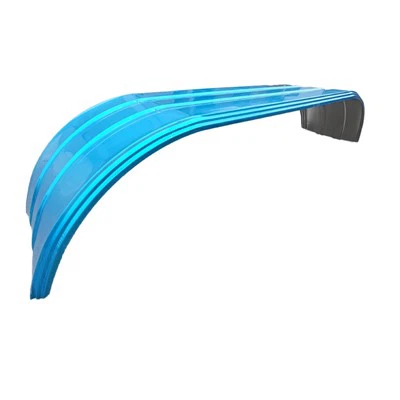
If your trailer has multiple axles, you may need to measure the fender in sections. For example, in a Heavy Duty Curved Triple Axle Trailer Fender, you might measure the length over each axle area separately. This can help you ensure that the fender provides adequate coverage for each axle.
Step 2: Measuring the Width
The width of the fender is measured at its widest point. Usually, this is near the center of the fender. Place the straight edge across the fender at its widest point, making sure it is perpendicular to the length of the fender. Then, use the tape measure to measure the distance between the two outer edges of the fender where the straight edge intersects. This measurement gives you the width of the fender.
Keep in mind that the width can vary depending on the type of trailer and the design of the fender. For instance, a Heavy Duty Curved Dual - Axle Truck Fender may have a different width compared to a single - axle trailer fender.
Step 3: Measuring the Height
The height of the fender is measured from the bottom edge to the top edge. Place the tape measure vertically at the side of the fender, starting from the lowest point on the bottom edge and extending it to the highest point on the top edge. This measurement is important as it determines how much of the wheel and tire the fender will cover.
Step 4: Measuring the Curve
Many trailer fenders have a curved shape. To measure the curve, you can use a flexible tape measure. Place the tape measure along the curve of the fender and note the length of the curve. You can also measure the radius of the curve if you have the necessary tools. This information can be useful when selecting a replacement fender, especially if you want to maintain the original look and fit of the trailer.
Step 5: Measuring the Mounting Holes
If you are replacing an existing fender, measuring the mounting holes is crucial. Use the tape measure to measure the distance between the centers of the mounting holes. Measure both the horizontal and vertical distances. This will ensure that the new fender can be easily mounted in the same location as the old one.
Special Considerations for Different Types of Fenders
- Aluminum Fenders: Trailer Aluminum Fender are lightweight and corrosion - resistant. When measuring aluminum fenders, be careful not to scratch the surface. The measurement process is the same as for other types of fenders, but you may need to pay extra attention to the edges as they can be sharp.
- Custom - Shaped Fenders: Some trailers may have custom - shaped fenders. In such cases, you may need to take additional measurements or use templates to ensure a proper fit. You can create a template by tracing the outline of the old fender on a piece of cardboard or paper.
Double - Checking Your Measurements
Once you have taken all the measurements, it's a good idea to double - check them. Measure each dimension at least twice to ensure accuracy. If there are any discrepancies between the measurements, take a third measurement to confirm the correct value.
Using Your Measurements to Select a Fender
After you have accurate measurements, you can use them to select the right trailer fender. At our company, we offer a wide range of trailer fenders in different sizes, shapes, and materials. Our team of experts can help you find the perfect fender for your trailer based on your measurements.
Contact Us for Your Trailer Fender Needs
If you're in the market for a new trailer fender and need further assistance with measurements or product selection, don't hesitate to contact us. We're here to help you make the right choice. Whether you need a Trailer Aluminum Fender, a Heavy Duty Curved Triple Axle Trailer Fender, or a Heavy Duty Curved Dual - Axle Truck Fender, we have the expertise and the products to meet your requirements.
References
- Trailer Industry Handbook: A comprehensive guide to trailer components and measurements.
- Manufacturer's specifications for trailer fenders.